

An Extension Allows More Time Not Time to Pay
Most farmers have filed already but if you have not filed, make sure to do an extension by tomorrow and pay in at least 90% of your total tax bill

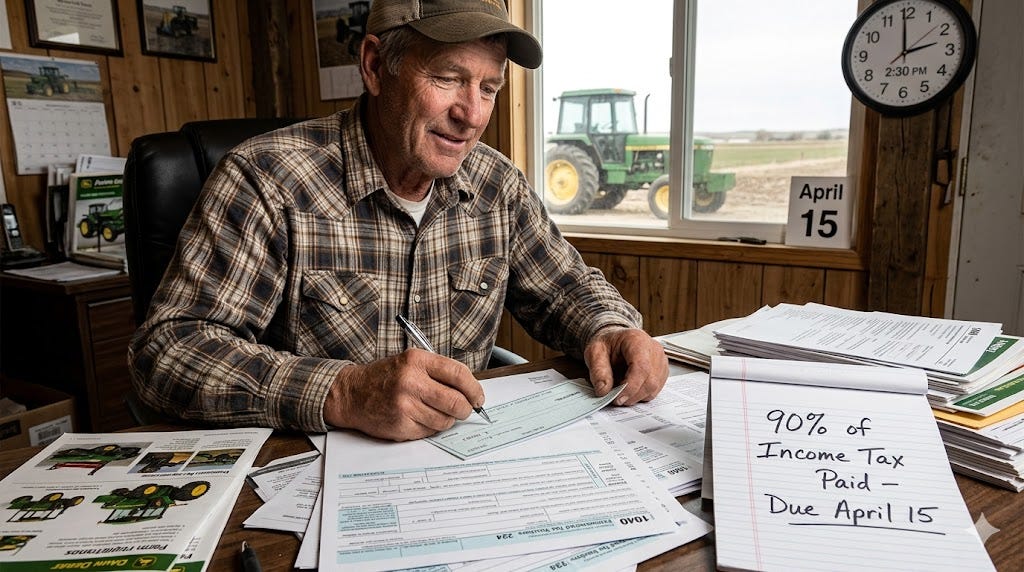
If you’re a farmer planning to file Form 4868 to extend your 2025 tax return, there’s one thing to understand before anything else: the extension buys you more time to file, not more time to pay. April 15, 2026, is still the deadline for paying what you owe, and missing that mark can cost you.
Many farm operators know that qualifying farmers have some built-in flexibility around estimated tax payments. For example, you can often make a single payment by January 15 or file and pay in full by early March to avoid the estimated-tax underpayment penalty. That’s a real benefit. But it’s a separate rule from what happens when you extend. Once you file a Form 4868, the IRS still expects the bulk of your 2025 tax to be in by April 15, regardless of the farming rules.
The 90% Rule: Your Practical Target
The practical benchmark to aim for is simple: have at least 90% of your total 2025 tax liability paid in by April 15. That includes withholding, prior estimated payments, and any additional payment you send with the extension form. If you hit that threshold and pay the remaining balance when you file by October 15, you can generally avoid the standard failure-to-pay penalty during the extension period.
One point worth clarifying: the 90% target doesn’t mean you should lowball your estimate on Form 4868. The IRS requires a good-faith, reasonable estimate of your full tax liability on the form itself. The 90% rule is simply a payment threshold. It’s what protects you from the penalty, not an excuse to underestimate.
What the Penalty Looks Like — and What It Costs
The standard late-payment penalty is 0.5% per month on the unpaid balance, capped at 25%. It runs from April 15, not from the extended filing deadline. So, if you owe $10,000 and haven’t paid enough, that penalty starts ticking in April even though your return isn’t due until October.
Here’s a quick illustration. Suppose your total 2025 tax is $40,000 and you’ve only paid $30,000 by April 15 which is short of the 90% mark. You file the extension but send no additional payment, then pay the $10,000 balance in October. At 0.5% per month over roughly six months, the penalty comes to around $300. Add interest at approximately 6.5% annually (a blended rate based on the IRS’s published 2026 quarterly rates) and you’re looking at another $325 in interest, for a total added cost of about $625.
Now run the same scenario where you send an additional payment with the extension to get to $36,000 paid which is exactly 90%. The same $4,000 balance sits unpaid from April to October, but the late-payment penalty goes away. Interest still applies, coming to roughly $130. That’s the difference between a $625 bill and a $130 one, just by getting that extra payment in the door by April 15.
Interest Is Always in the Picture
Even if you avoid the penalty entirely, the IRS charges interest on any unpaid 2025 tax starting April 16 and running until you pay. For 2026, the individual underpayment rate is 7% annually for Q1 and 6% for Q2, with later quarters subject to change. Interest is compounded daily, so it adds up even if the rate seems modest. There’s no way around it. The only question is whether you’re paying interest alone or interest plus a penalty.
The Bottom Line
For most farmers using Form 4868 this spring, the extension itself is straightforward. The more important question is how much to pay with it. Getting to 90% of your estimated 2025 tax by April 15 won’t stop the interest clock since nothing will. But it can keep the penalty out of the picture and meaningfully reduce what you owe when you file in the fall. If you haven’t already run an estimate of where you stand, now is a good time.