



The last two crops I ran were lopsided. Dry peas went almost entirely to ARC-CO; grain sorghum went entirely to PLC. Canola is neither. Run the 2025 numbers across the five big canola states and you get a genuine split — some counties want ARC-CO, some want PLC, and the line between them is drawn by one thing: how your 2025 crop came in.
Here is the takeaway. Idaho leans ARC-CO. North Dakota and Minnesota lean PLC. Montana and Washington are close calls that break county by county. Canola is the one crop in this series where you cannot assume the answer — you have to look up your own county.
Why canola splits when peas and sorghum didn’t
Two things put canola on the fence.
First, the PLC rate is thin. The effective reference is $0.2375 a pound and the projected MYA price is $0.2070, so the PLC rate is just $0.0305 a pound. On 80% of a benchmark yield, that is a real check but not a big one — roughly $35 to $50 an acre in most counties. It does not run away from ARC the way sorghum’s fat $1.12 rate did.
Second, the price is already below the benchmark. The benchmark price is $0.2595 and the MYA is $0.2070 — about 80% of benchmark. That means even a normal crop can dip below the 90% revenue guarantee on price alone, which keeps ARC-CO in the game far more than it was for sorghum.
So the decider is yield. Where the 2025 crop came up short, ARC-CO pays and usually wins. Where the crop was strong, county revenue clears the guarantee, ARC pays nothing, and the steady PLC check takes it.
Two counties that show both sides
Pembina County, North Dakota — the bumper crop that sends you to PLC. Benchmark yield 2,424 pounds; the 2025 crop came in at 2,914 — about 120% of normal.
Benchmark revenue: 2,424 × $0.2595 = $629/acre
Guarantee (90%): $566/acre
2025 actual revenue: 2,914 × $0.2070 = $603/acre
County revenue beat the guarantee, so ARC-CO pays $0. PLC still pays about $50 an acre on the price gap. A big crop and a soft price is a PLC story, and most of North Dakota and Minnesota look like this.
Teton County, Montana (dryland) — the short crop that sends you to ARC. Benchmark yield 1,772 pounds; the 2025 crop was 1,034 — about 58% of normal.
Benchmark revenue: $460/acre; guarantee (90%): $414/acre
2025 actual revenue: 1,034 × $0.2070 = $214/acre
Revenue shortfall of $200 an acre, capped at 12% of benchmark → ARC-CO pays about $47 an acre, against PLC’s $37.
A short crop tips the county to ARC-CO — but notice the 12% cap is still working: the county lost $200 an acre and ARC covers $47 of it. The cap that dominated the pea story is here too, just not enough to matter against canola’s thin PLC rate.
The state-by-state picture
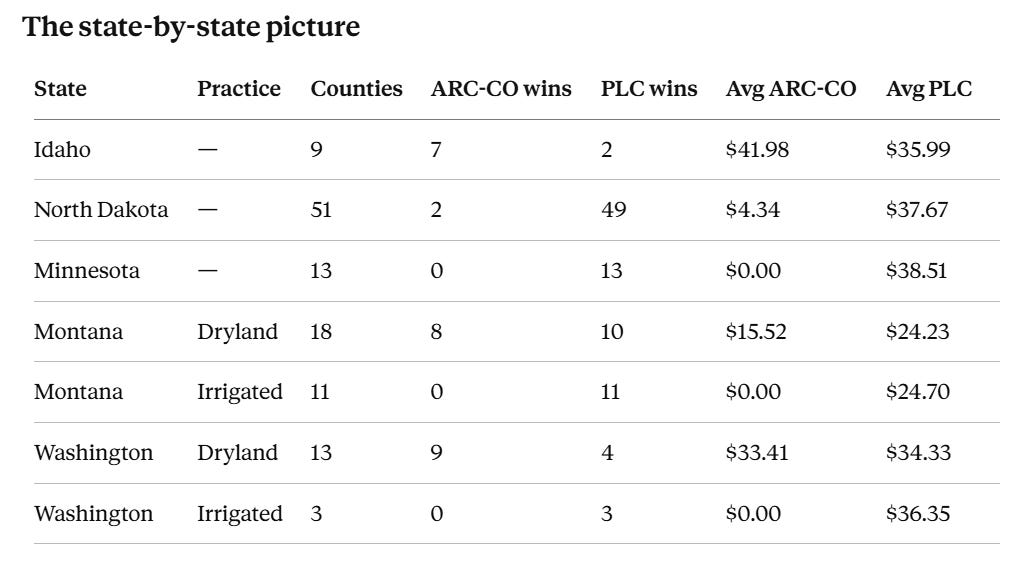
Two things stand out. Idaho is the ARC-CO state — dryland canola there ran short of benchmark, and seven of nine counties pay more under ARC. And the irrigated lines are unanimous: wherever a county was irrigated, the crop was big, ARC-CO drops to zero, and PLC wins every time. The fights are all on dryland ground.
Washington dryland is the closest call of all — ARC-CO actually wins nine of thirteen counties on a head-to-head basis, even though a few high-benchmark counties nudge the statewide PLC average a hair higher. That is exactly why an average won’t answer this for you.
The bottom line
For 2025 you do not elect — OBBBA pays the higher of ARC-CO or PLC automatically, county by county. So, the split does not cost you anything; you get whichever is bigger without lifting a finger. But canola is the crop where the answer really does change with your county and your practice, so it is worth pulling yours up. Where the file reports an irrigated county, expect PLC. Where dryland yields fell short — much of Idaho, western Montana, the Washington dryland belt — expect ARC-CO to carry it.
Know your county’s benchmark and your own PLC yield before you plan around a number. The county spreadsheets behind this let you drop in your base acres and PLC yield and see the higher-of figure for your operation.
Estimates use the official FSA 2025 ARC-CO canola benchmark yields, real RMA harvested county yields, the $0.2595/lb benchmark price, the $0.2375 effective reference, and the projected $0.2070/lb MYA price. Where a county reports two yields, the lower is dryland and the higher is irrigated.
Here are the spreadsheets (for paid subscribers only):
